

|
|
|
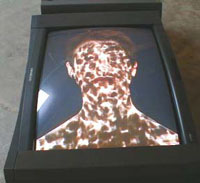
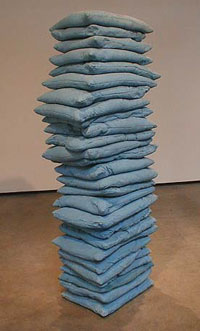
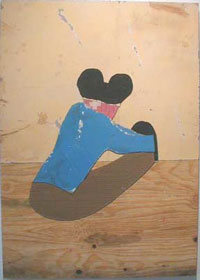
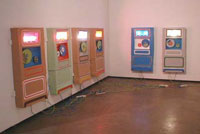
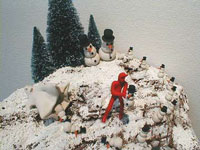
Tire Iron #13 6/7/01 Big as Texas Spring is in the air; DiverseWorks' Big as Texas show mixes new work from new artists and some peppy contributions from the usual suspects. Refreshing. Despite the inevitable peaks and valleys of a big group show, the energy at the opening was high, and gave me a welcome sense that there is some life left in the Texas contemporary art world. It's the best showcase of new work I've seen in a while, and shows admirable curatorial perseverance: Sara Kellner, Diane Barber and Paul Arensmeyer, the co-curators, turned over some new rocks in their Texas art hunt, going as far as Marfa to do it. Here are my picks; for the sake of argument, I'll put them in order, best first, so you can disagree with greater precision: Ludwig Schwarz's Great Moments in Painting Number Two is a viciously funny comparison of the real world and its virtual, on-line cyber equivalent. Six pastel canvasses are stacked against the wall; we can only see the one on top. Standard vinyl wall text gives the URL for the piece, the website for which consists solely of a photograph of the six paintings spread out so we can see them. Schwarz, in a razor sharp stroke not only admits, but exploits what we all suspected: everything's more interesting if it's virtual. Christopher French's Please More/Please No More is sexy. A pair of TVs shows the heads and nude shoulders of a man and a woman who stare impassively as sooty fingerprints apply themselves all over their faces against a background of heavy breathing. Knowing that the couple in the videos are the artist and his partner gives the piece an uncomfortably personal slant; we're all used to provocative imagery, but rarely is it someone we know, and even more rarely is it a portrayal of a real relationship. French's sexual portrait of two real-life, middle-aged people is almost unique. This PG-13 piece isn't explicit or shocking, just suggestive; what makes it provocative is its sincerity. Also, the custom stand neatly transforms two television monitors into a credible sculpture, an elegant solution to the video-in-a-gallery problem. Randy Wallace's Shingle is a giant playing card casually stuck into the gallery wall. Plates of window glass adhere to the underside on smears of viscous yellow grease. The piece has a vivid tactile unpleasantness like fingernails on a blackboard. Its muscular disregard for niceties gives the piece a grotesque joie de vivre. Meg Langhorne's Blue Princess, an unsteady column of concrete pillows, has a figurative dynamism that takes it beyond mere formal translation. The hardened cushions retain a flabby, pliable pose, further softened by a powder blue tint. Chuck Ramirez digital trash bag photos invite voyeurism — we peek at half-hidden discards through filmy white plastic, making instant personality profiles of the discarders. Fitness and Vegan are best, simulating real trash, while Black Bag is too straightforwardly S/M, as well as being opaque, to hold as much interest. Amazing trompe l'oeil technique piles a second layer of bizarre fetishism onto Kirk Hayes' creepy, psychologically charged images. Always a little askew, Hayes faux collages place abject characters into odd, uncomfortable predicaments. Of his three works, Mouse-o-Tear is the most disturbing; an awkward figure bends to put its feet and hands into a tiny mouse hole in a pathetic attempt at hiding. Justin Kidd's Control Room uses funky playpen technology to create a 1950's computer center. The best part is the mess of trailing cords, each color coded with sloppy vinyl tape in a clunky parody of high technology. Scott Burns' narrative tableaux place tiny devils, snowmen, ghosts and robots into rocky HO-scale foam landscapes; their infernal activities occasionally resonate with unsettling subconscious associations. Burns' rocky snowscapes are almost too well made; though they skillfully stage-manage the narrative action, interesting miniature details distract from the mini-psychodrama at the center of each piece. Michael Roch's mythic plaster animals have expressive gestures. Hilary Harnischfeger's resin and glitter wall reliefs have a nice deco overkill. I like shows without themes. Curators Kellner, Barber and Arensmeyer have reached a dip net into the Texas art aquarium and caught some keepers. Congrats, everyone! - Bill Davenport
Bill
Davenport is an artist and writer from All imges courtesy the artists and DiverseWorks.
|
|
|
|
|
||